
How to Do Well in Quality Control for Zipper Manufacturing
Quality control is one of the most important factors in zipper manufacturing. Even though zippers are small components, their performance directly impacts the usability, appearance, and durability of finished items like clothing, bags and outdoor gear. If a zipper fails during use, it can harm customer satisfaction and also put the brand image at risk. Because of that, manufacturers have to establish effective zipper quality control systems meets strict requirements.
Doing well in quality control for zipper manufacturing needs more than just inspecting the final item. It includes overseeing every phase of production, starting with picking suitable raw materials, then controlling manufacturing processes, then doing performance tests, and finally continuing to refine production methods. With a full and careful approach, manufacturers can reduce defects, raise operational efficiency, and keep delivering uniform zipper quality.
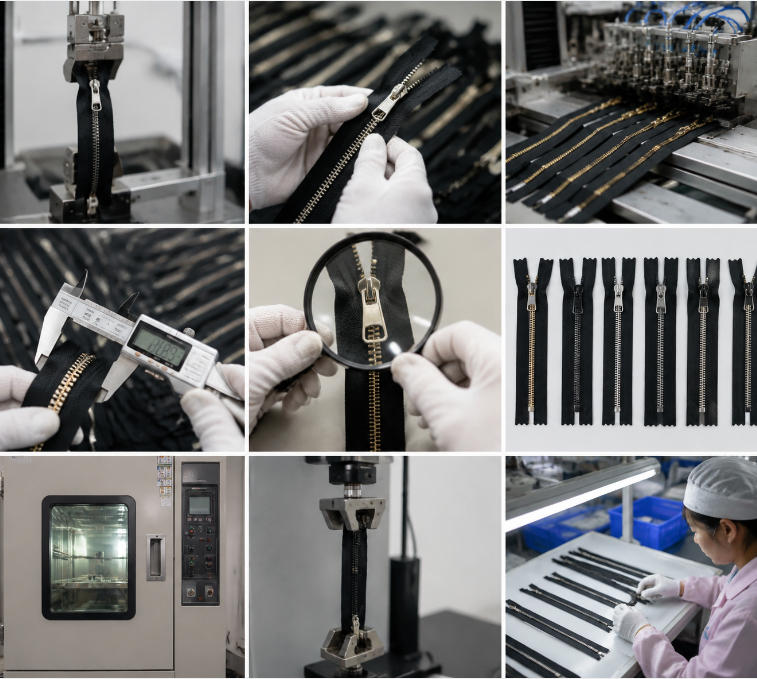
Why Quality Control in Zipper Manufacturing is Critical
Quality control helps zipper manufacturers keep a steady level of product performance across the whole making process. Since zippers are frequently exposed to repeated tugging, bending, laundering, and all kinds of outdoor or indoor environmental conditions, each part has to match certain standards.
Effective quality control can help manufacturers:
- Improve zipper durability and long service life
- Lessen production defects and reduce customer complaints
- Keep zipper movement smooth
- Maintain a consistent look, plus stable dimensions
- Meet international quality rules and customer needs
- Enhance competitiveness in global markets
Starting from raw material inspection to the final product inspection, every stage in zipper production needs close attention and careful watching, even the small things.
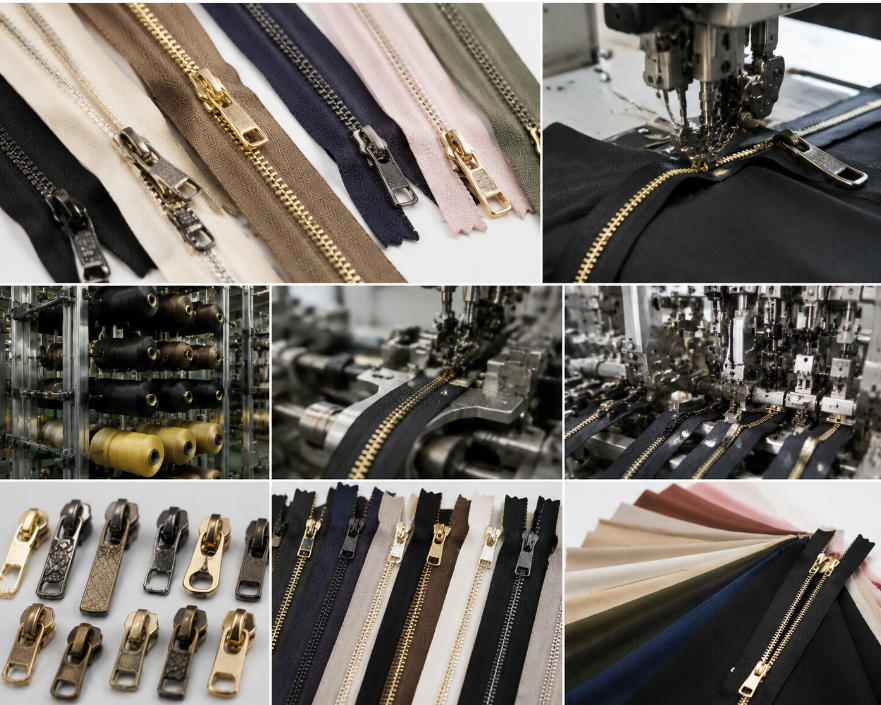
Key Steps of Quality Control in Zipper Manufacturing
1. Establish Strict Raw Material Quality Control
The first step for getting great zipper quality is managing the quality of the raw materials. Zippers are built from several parts, like zipper teeth, sliders, fabric tapes, stops, and pull tabs. Each part has a meaningful role in the overall performance so it needs attention, not only assembly.
The following chart provides the raw material selection and inspection methods for quality control in zipper manufacturing
| Raw Material | Quality Control Factors | Importance | Common Inspection Methods |
| Metal Materials (Brass, Aluminum, Zinc Alloy) | Material strength, hardness, corrosion resistance, surface finish, dimensional accuracy | Ensures zipper teeth and sliders have sufficient strength, durability, and resistance to wear and rust | Hardness testing, tensile testing, surface inspection, corrosion testing |
| Zipper Teeth Materials | Tooth size consistency, shape accuracy, alignment, attachment strength | Properly formed teeth ensure smooth slider movement and prevent jamming or separation | Dimensional measurement, alignment inspection, pull strength testing |
| Fabric Tape | Tensile strength, weaving density, thickness consistency, flexibility, color fastness | Provides support for zipper components and affects overall durability and appearance | Tensile testing, thickness measurement, color inspection, stretch resistance testing |
| Nylon Coil Materials | Flexibility, abrasion resistance, temperature resistance, coil uniformity | Determines smooth operation and durability of nylon coil zippers | Flexibility testing, wear testing, dimensional inspection |
| Plastic Resin Materials | Impact strength, hardness, chemical resistance, molding stability | Affects the performance and appearance of plastic molded zippers | Material composition analysis, impact testing, surface inspection |
| Slider Materials | Strength, weight consistency, surface quality, corrosion resistance | Ensures smooth opening and closing and prevents the deformation of zipper sliders | Pull testing, movement testing, coating inspection |
| Pull Tab Materials | Strength, attachment reliability, surface finish, design accuracy | Provides user control and must withstand repeated pulling forces | Tensile testing, visual inspection, attachment strength testing |
| Thread and Sewing Materials | Tensile strength, abrasion resistance, color consistency, durability | Ensures secure attachment between zipper tape and finished products | Thread strength testing, sewing quality inspection |
| Dyes and Coating Materials | Color stability, adhesion, environmental resistance, uniformity | Maintains zipper appearance and prevents fading or surface damage | Color testing, adhesion testing, chemical resistance testing |
| Packaging Materials | Protection strength, moisture resistance, labeling accuracy | Prevents damage during storage and transportation while maintaining product traceability | Packaging inspection, moisture testing, label verification |
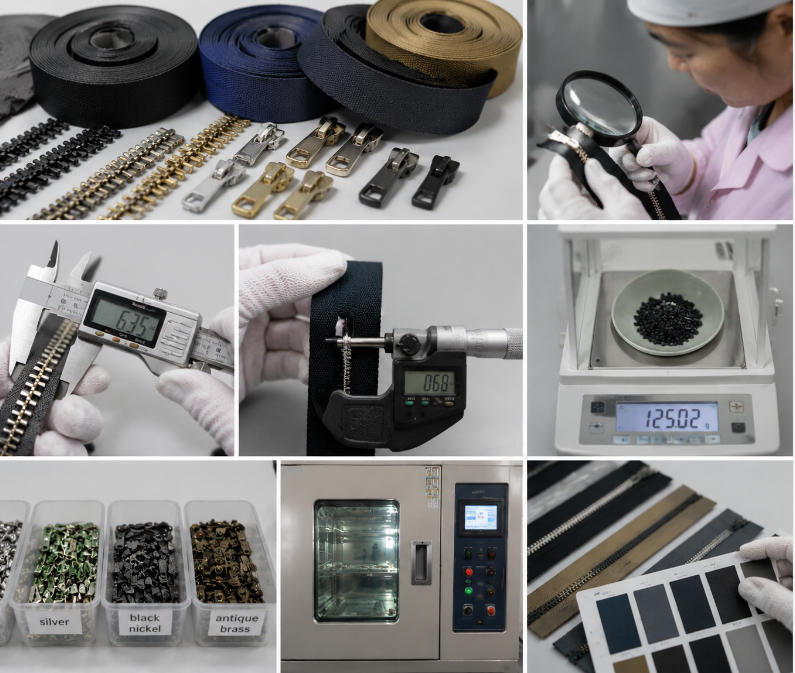
2. Maintain Precision During the Manufacturing Process
Zipper production requires careful accuracy, because small mistakes can harm how the zipper works in daily use. Keeping tight control at every stage of production is essential for dependable results.
For tooth production, manufacturers should confirm that the teeth keep consistent dimensions, steady spacing, and correct alignment. When tooth shaping is done properly, the slider glides smoothly, and issues such as jamming or tooth detaching are avoided.
Putting in the sliders and stops also needs careful control. The slider has to sit in the right way with the zipper teeth, while top and bottom stops must be fastened securely to keep the slider from slipping off. Regular checks for equipment calibration and routine process monitoring, keep manufacturing accuracy steady and more reliable.
Advanced production machinery paired with experienced operators can improve regularity and reduce the differences between zipper batches.
3. Implement In-Process Quality Inspection
Quality control should not wait until the final product stage. Continuous checks during production let manufacturers spot trouble early, and it also lowers wasted material.
During manufacturing, quality inspectors should watch key production points, like tooth attachment, tape sewing quality, slider installation, and surface finishing. If a defect shows up, the production team can trace the cause quickly and make adjustments before large amounts of defective products get produced.
In-process inspection also lets manufacturers keep production standards steady. If they log the inspection results and also examine the production data, the factories can notice the same trouble showing up again and again, and then they can make their manufacturing method more precise.
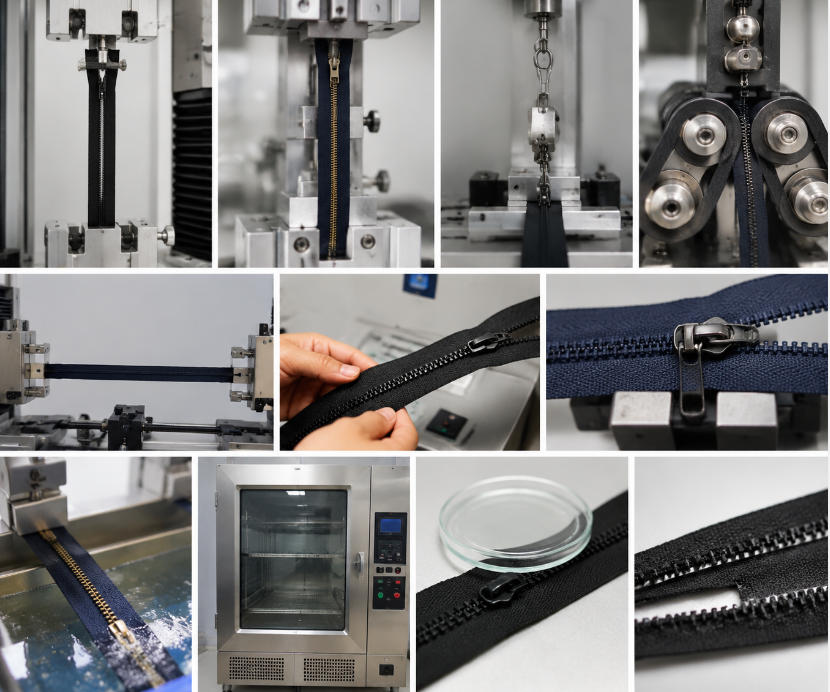
4. Conduct Comprehensive Performance Testing
A good zipper should not only look good but also work dependably in varied situations. Because of that, performance testing becomes a key part of zipper quality control.
Strength testing looks at whether zipper parts can handle pulling force during normal everyday use. The manufacturer should test the strength of zipper teeth, slider pieces, stops, and fabric tapes to confirm they satisfy the needed requirements.
Durability testing matters too. The zipper needs to be tested through many repeated open close cycles, to imitate long run usage. That helps them see if the slider stays smooth, and whether the teeth continue to engage properly after time passes.
For specialized uses like outdoor apparel or industrial goods, there may be extra tests that need to be done. Sometimes that means checking wash resistance, corrosion resistance, resistance to heat exposure, and assessing environmental durability too.
5. Improve Appearance Inspection Standards
For many customers, particularly in fashion, the zipper look matters just as much as performance. If the zipper shows visible defects, it can lower the perceived quality of the final item.
Manufacturers should set firm appearance inspection rules covering color, surface finish, seam work, and how well the parts are assembled. Inspectors need to look for problems including scratches, smudges, uneven coating, stray loose threads, and also color mismatch between different sections.
Using automated visual inspection systems can raise inspection accuracy, and also cut down on human mistakes. These systems can spot surface defects quickly, and help keep the same level of quality across high-volume production runs.
6. Use Advanced Quality Control Technologies
These days zipper manufacturing is getting more automated, so using up-to-date tools can really help the quality checks run more efficiently, and with less hassle. Machine vision systems can scan zipper parts with strong precision and spot defects that a person might miss, especially when the issues are small. Then automated testing equipment can evaluate zipper strength, resistance to movement, and overall durability in a more steady manner.
Along with that digital quality management systems let manufacturers record production details, review how often defects happen, and strengthen decision-making. When factories gather real-time production data, they can react quickly to quality problems and fine-tune manufacturing procedures, sometimes even before a batch grows larger.
Investing in advanced technology allows zipper manufacturers to achieve higher accuracy, faster inspection, and better product consistency.
7. Train Employees and Build a Quality Culture
Even with more advanced equipment, employees are still a key part of quality control, and people sometimes underestimate that. Good instruction makes sure workers get the production standards, the inspection methods, and why they must keep product quality stable.
Manufacturers should run frequent training programs that include how to operate the equipment, how to spot defects, safety steps, and the quality requirements too. Workers should be motivated to flag potential problems and take part in enhancement activities, not just wait around for someone else to notice.
If a strong quality culture exists, then every employee takes responsibility for product quality, rather than depending only on the last-stage checks.
8. Establish a Continuous Improvement System
Effective quality control really needs ongoing progress, not a one-time push. Manufacturers should regularly look through inspection numbers, customer reactions, and how production is performing to find chances for betterment.
When defects show up, factories should look for the root cause, not just treat each little problem right away. For instance, repeated slider failures can come from material issues, improper assembly, or even wrong equipment settings. If you can find the real reason behind it, manufacturers are able to roll out effective solutions that actually stick.
Continuous improvement helps lower production costs, raise efficiency, and keep consistent zipper quality across time.
9. Strengthen Supplier and Customer Communication
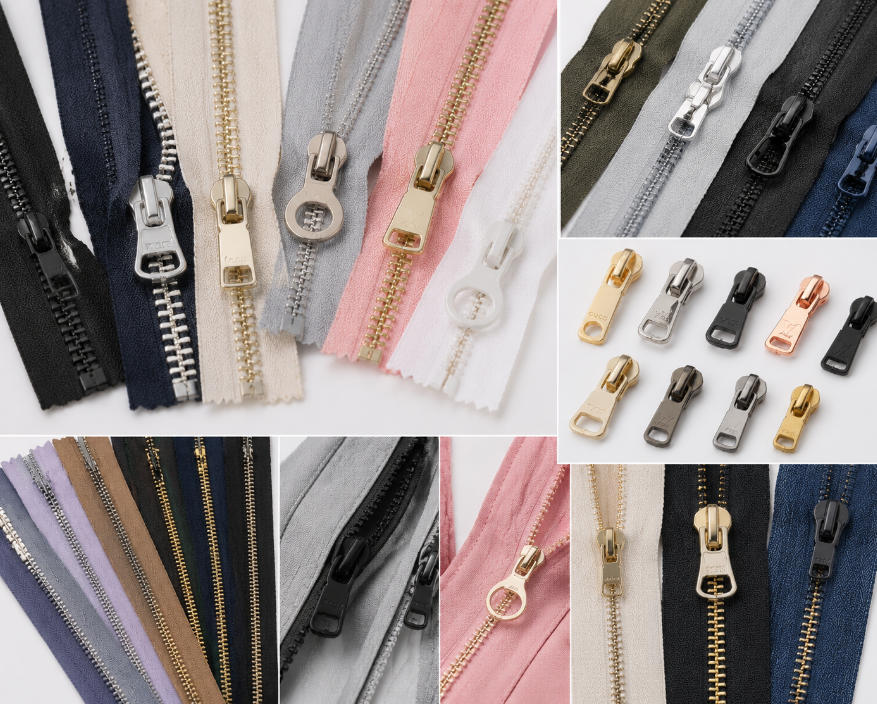
Quality control also leans on clear communication with suppliers and customers. Collaborating closely with trustworthy suppliers helps keep material quality steady, and it supports timely improvements when something goes wrong.
At the same time, figuring out customer needs helps manufacturers give the right zipper solutions, in a more fitting way. Different uses might call for various zipper materials, sizes, levels of strength, or even special surface finishing methods. If communication stays clear it reduces wrong assumptions, and also makes sure the products match those specific expectations, without missing details.
Common Defects and Solutions in Zipper Manufacturing
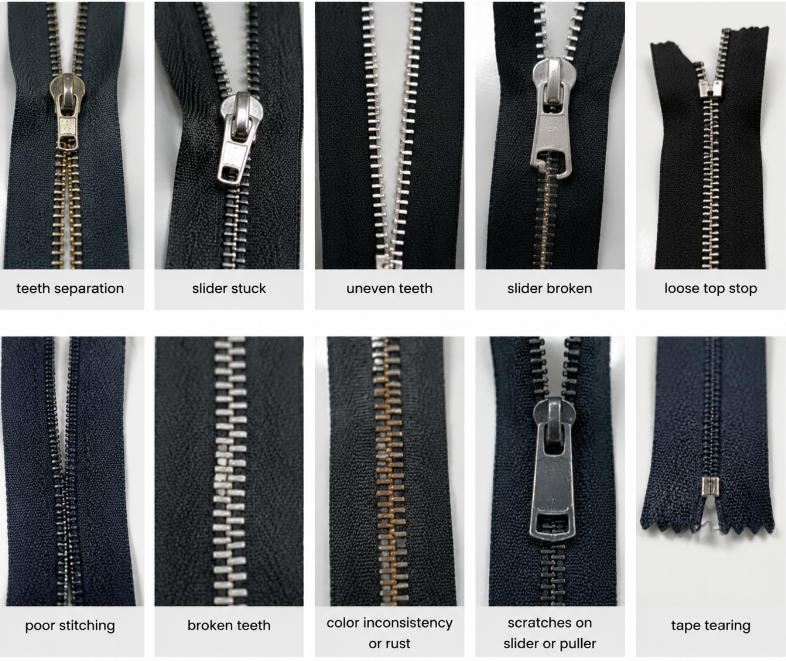
Even with strict controls, manufacturing defects may occur. Identifying and correcting these problems helps improve overall manufacturing efficiency.
| Common Defects | Possible Causes | Impact on Zipper Performance | Quality Control Solutions |
| Slider Gets Stuck or Moves Poorly | Incorrect tooth size, poor slider fitting, uneven tooth alignment, insufficient lubrication | Makes the zipper difficult to open and close and affects user experience | Check tooth precision, improve slider matching, perform movement testing, apply proper finishing treatments |
| Zipper Teeth Separation | Weak tooth attachment, incorrect tooth spacing, low-quality materials, insufficient pressing force | Causes zipper failure and reduces product durability | Conduct tooth strength testing, improve forming processes, inspect tooth engagement accuracy |
| Broken Zipper Teeth | Poor material strength, improper molding, excessive stress during use | Prevents smooth zipper operation and may cause complete zipper failure | Use higher-quality materials, test tooth hardness and impact resistance, optimize production parameters |
| Slider Breakage or Deformation | Weak slider material, incorrect casting or molding process, excessive pulling force | Leads to zipper malfunction and reduced service life | Perform slider strength testing, inspect material quality, improve manufacturing precision |
| Loose or Detached Top/Bottom Stops | Improper installation, insufficient holding force, poor-quality stop materials | Allows the slider to come off or reduces zipper safety | Test stop attachment strength, adjust installation pressure, inspect stop positioning |
| Zipper Tape Tearing | Low-strength fabric, poor weaving quality, weak stitching, excessive tension | Reduces overall zipper strength and causes separation from the product | Test tape tensile strength, improve fabric selection, inspect sewing quality |
| Uneven Tooth Alignment | Machine calibration errors, inaccurate tooth placement, inconsistent production settings | Causes zipper jamming and irregular movement | Calibrate production equipment, monitor tooth positioning, use automated inspection systems |
| Color Difference Between Components | Inconsistent dyeing, different material batches, poor color matching | Affects product appearance, especially in fashion applications | Conduct color inspection, establish color standards, control dyeing processes |
| Surface Scratches or Defects | Poor handling, improper finishing, equipment wear, contamination | Reduces visual quality and product value | Perform surface inspection, improve handling procedures, maintain equipment regularly |
| Loose Stitching on Zipper Tape | Incorrect sewing tension, poor thread quality, improper machine settings | Weakens zipper attachment and reduces durability | Monitor sewing parameters, inspect stitching quality, use stronger threads |
| Rust or Corrosion on Metal Zippers | Poor coating, low corrosion resistance, exposure to moisture | Reduces appearance and functional lifespan of metal zippers | Conduct salt spray testing, improve surface treatment, select corrosion-resistant materials |
| Slider Pull Tab Failure | Weak attachment, poor material strength, improper assembly | Makes the zipper difficult to operate and reduces reliability | Test pull tab strength, improve assembly accuracy, inspect attachment points |
| Zipper Length Inconsistency | Cutting errors, inaccurate measurements, production variations | Causes installation problems in finished products | Use precision measuring tools, automate cutting processes, perform size inspections |
| Poor Zipper Smoothness | Rough teeth surfaces, incorrect slider pressure, lack of finishing treatment | Creates uncomfortable operation and increases wear | Conduct opening/closing tests, optimize slider design, improve surface finishing |
| Batch-to-Batch Quality Variation | Inconsistent raw materials, unstable production processes, insufficient monitoring | Leads to unreliable product quality and customer complaints | Strengthen supplier control, use production data tracking, implement continuous quality improvement systems |
Quality Control Equipment in Zipper Manufacturing
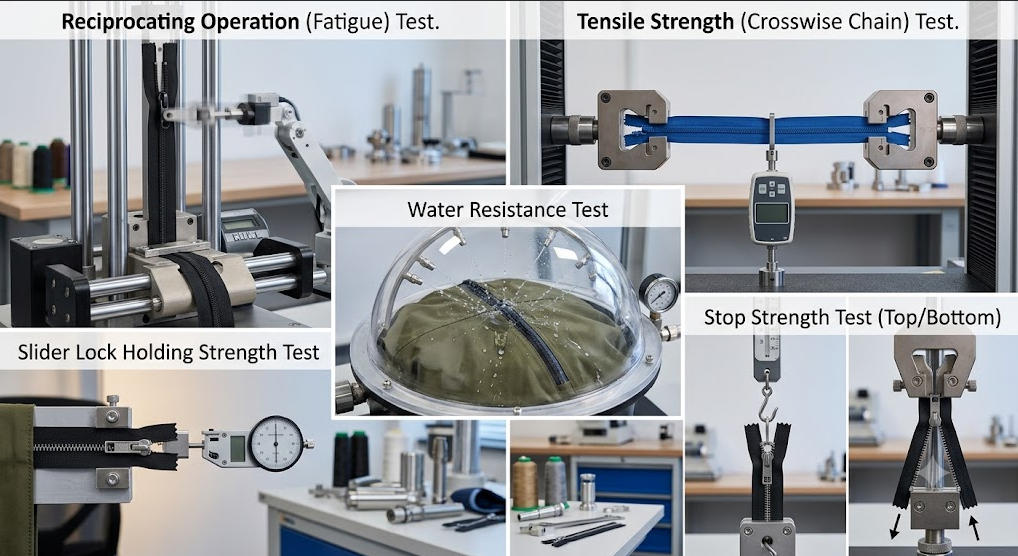
Modern zipper factories use advanced inspection equipment to improve accuracy and efficiency.
| Quality Control Equipment | Main Testing Function | Quality Parameters Checked |
| Tensile Testing Machine | Measures the strength of zipper components under pulling force | Tape strength, slider attachment strength, top stop strength, bottom stop strength |
| Zipper Opening and Closing Testing Machine | Simulates repeated zipper operation cycles | Smooth movement, durability, slider performance, tooth engagement |
| Tooth Alignment Inspection Equipment | Checks the positioning and consistency of zipper teeth | Tooth spacing, tooth height, alignment accuracy, tooth shape |
| Digital Measuring Instruments | Provides precise dimensional measurements | Zipper length, tooth size, slider dimensions, tape thickness |
| Color Inspection System | Detects color differences between zipper components | Tape color, tooth color, slider finish, dye consistency |
| Salt Spray Testing Machine | Tests corrosion resistance of metal zipper components | Rust resistance, coating durability, surface protection performance |
| Hardness Testing Machine | Measures material hardness | Metal tooth hardness, slider hardness, alloy strength |
| Friction Testing Equipment | Measures resistance during zipper operation | Slider movement force, smoothness, friction performance |
| Pull Force Testing Equipment | Evaluates the strength of zipper pulls and attachments | Pull tab strength, slider connection strength, component durability |
| Abrasion Testing Machine | Tests resistance to repeated wear | Tape durability, surface wear resistance, coating performance |
| Environmental Testing Chamber | Simulates different environmental conditions | Temperature resistance, humidity resistance, material stability |
| Microscope or Magnification Inspection Tools | Provides detailed observation of small components | Tooth surface quality, cracks, coating defects, manufacturing flaws |
| Coating Thickness Gauge | Measures protective coating thickness on metal parts | Coating uniformity, surface protection level |
| Sewing Quality Inspection Equipment | Checks zipper tape stitching quality | Stitch density, thread strength, sewing consistency |
Final Thoughts
Doing well with quality control in zipper production needs a full plan that covers materials, production processes, testing, technology, and employee management. When strict inspection routines are in place, when manufacturing precision is kept high, and when advanced tools are adopted and the process keeps getting refined, zipper manufacturers are better positioned to deliver zippers with strong reliability and long-lasting durability.
Strong quality control not only lowers the number of defects, but it also builds stronger customer trust and competitiveness in the global market. For zipper manufacturers, quality is not only that final check at the end, it is also a real commitment that gets embedded into every stage of production.