
Why Are Some Clothing Zippers on the Left and Others on the Right?
If you have ever worn two jackets from different brands, you may have noticed a small difference: the zipper pull is on the left side of one jacket and the right side of another. It is easy to assume that one of them is simply made differently, but the difference is usually intentional.
The question becomes more interesting when you compare men’s and women’s clothing. Traditionally, men’s garments tend to have zippers on the right, while women’s garments tend to have them on the left. But where did this convention come from? And does it still matter when designing clothing today?
The answer involves an old clothing tradition, modern design choices, and a surprisingly important detail in zipper manufacturing. As a zipper manufacturer, we regularly handle open-end and closed-end zipper orders, so specifying the correct direction is a practical part of garment production.
Why Do Men’s and Women’s Clothing Have Different Sides?
The difference in clothing sides actually goes back to a much older detail: buttons.
For a long time, men’s shirts, coats, and jackets were generally made with buttons on the wearer’s right side, while women’s clothing was more often designed with buttons on the left. There is no single explanation for how this tradition started, but a few theories are often mentioned.
One of them has to do with the way people dressed. Men were typically expected to dress themselves, so having the buttons on the right may have been more convenient for the dominant hand. Women’s clothing, particularly among wealthy women, could be much more complicated. Dresses and other garments were sometimes fastened by a maid or servant, and the arrangement may have been easier for someone standing in front of the wearer.
There are also theories involving military uniforms, historical clothing styles, and the way weapons were carried. These ideas are often repeated, but the historical evidence is not strong enough to say that any one of them was definitely the reason.
What we do know is that the left-right convention became established over time. Once clothing manufacturers had adopted these patterns, there was little reason to change them.
Zippers came much later, but they entered a clothing industry that already had these conventions. As zippers became more common during the 20th century, their placement often followed the same left-right patterns used for buttons.
That is why the answer to “why are zippers left or right?” is not really about the zipper mechanism itself. In many cases, it is simply a matter of clothing tradition. The zipper inherited a convention that had already been around for generations.
Does the Left-Right Rule Still Apply Today?
Not really. At least, not in the strict way it once did.
Traditional men’s clothing is still commonly associated with right-side fastening, while women’s clothing often uses the left side. But if you look at modern clothing, the rule is far from consistent. You can find both directions across sportswear, outdoor jackets, workwear, unisex clothing, and everyday casual wear.
There is also a practical reason for this. A manufacturer may use the same zipper direction across several products simply because it makes production easier. In other cases, the design of the garment matters more than whether it is made for men or women.
For example, the position of pockets can affect where a zipper is placed. The same is true for overlapping panels, waterproof construction, or simply how the designer expects the garment to be opened and closed.
Outdoor and technical clothing is a good example. These garments are usually designed around function first. A waterproof jacket, for instance, may have a particular zipper arrangement because of the way its layers need to overlap or how the closure needs to work in use. Traditional gender-based conventions may have little influence on that decision.
And clothing is only part of the story. Zippers on bags, cases, and other products can open in either direction without following the traditional men’s or women’s clothing pattern.
So, while zipper direction can sometimes give you a clue about how a garment was traditionally categorized, it is not a reliable way to tell whether clothing is designed for men or women today. Modern zipper placement is usually a combination of tradition, function, construction, and the manufacturer’s design standards.
What Do “Left-Hand” and “Right-Hand” Zippers Actually Mean?
The terms left-hand and right-hand zipper can be surprisingly easy to mix up, especially when you are ordering zippers for a custom garment.
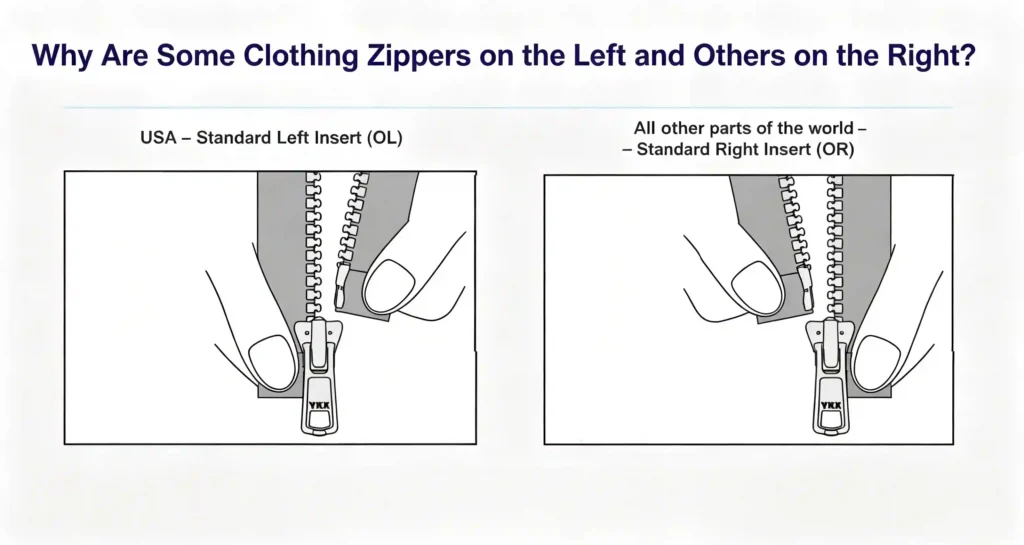
For a separating zipper, also called an open-end zipper, left and right are normally specified according to the position of the slider when the garment is being worn and the zipper is closed.
A right-hand zipper has the slider on the wearer’s right side when the zipper is closed. The insertion pin is on the left side.
A left-hand zipper has the slider on the wearer’s left side, with the insertion pin on the right.
This distinction matters because the two versions are not simply the same zipper turned around. The zipper components, tape arrangement, and assembly need to be produced for the required orientation.
For example, if a clothing brand develops a jacket that requires a left-hand open-end zipper but orders a standard right-hand version, the zipper may arrive looking perfectly normal but still be unsuitable for the garment.
That is why experienced buyers normally specify the direction clearly rather than simply asking for a “jacket zipper.”
Why Does Zipper Direction Matter in Manufacturing?
At the factory level, zipper handedness affects production, assembly, packaging, and final garment construction.
Standard zipper sizes and types may be available in one direction as regular stock, while the opposite direction may require a separate production specification. The exact availability depends on the zipper type, construction, size, and manufacturer.
For custom clothing, it is therefore useful to provide both the written specification and a simple reference image.
For example:
Right-hand open-end zipper, 5# nylon, 65 cm
or:
Left-hand open-end zipper, 5# molded plastic, 70 cm
An illustration showing the slider and insertion pin can remove any uncertainty between the designer, purchasing team, and zipper factory.
What About Closed-End Zippers?
The left-right issue is much less important with closed-end zippers.
A closed-end zipper has both ends permanently finished rather than separating at the bottom. This is common on trousers, pockets, bags, and other applications where the two sides do not need to come apart completely.
There can still be a preferred direction for the slider, especially when a zipper is installed in a particular garment design. However, the insertion-pin issue that makes left-hand and right-hand separating zippers especially important does not apply in the same way.
For open-front jackets, coats, and similar garments, specifying the correct direction is much more important because the two sides need to connect and separate correctly.
Tips for Clothing Brands to Check Before Ordering Zippers
If you are developing a new garment, it is worth confirming the zipper direction before placing the production order. It is a small detail, but changing it later can mean reworking the garment or ordering another batch of zippers.
Start by deciding whether you need a right-hand or left-hand open-end zipper. Avoid relying on terms such as “men’s zipper” or “women’s zipper,” since modern clothing does not always follow those traditional patterns.
Then look at the garment itself. The position of the pockets, front placket, overlapping fabric, and other hardware can affect how the zipper should be fitted. For outdoor or workwear, you may also need to consider options such as waterproof or two-way zippers, depending on how the garment will be used.
When sending the order, state the direction clearly. “Right-hand open-end” or “Left-hand open-end” is much more useful than simply asking for a “jacket zipper.”
A drawing, product photo, or physical sample can make things even clearer. It gives the supplier a direct reference and helps avoid mistakes caused by different interpretations of left and right.
If you need a specific zipper direction, two-way zipper, waterproof zipper, or customized slider for your clothing line, contact us with your garment specifications or sample, and we can help confirm the suitable zipper construction before production.