
Sustainable Zippers vs Traditional Zippers: Environmental Impact Comparison
As fashion and textile brands face growing pressure to reduce waste, lower emissions, and provide more transparent material information, even small components are receiving more attention. Zippers are one of them.
A zipper may represent only a small part of a jacket, bag, pair of trousers, or piece of outdoor equipment. However, the materials used to make it still have an environmental footprint. This raises a practical question for brands: Does switching from a traditional zipper to a sustainable zipper actually make a meaningful difference?
The answer is not simply that every recycled zipper is automatically better. The environmental impact depends on the material, recycled content, manufacturing process, surface treatment, durability, and what happens to the product at the end of its life.
This guide compares sustainable and traditional zippers across these stages and explains what brands should consider before making the switch.
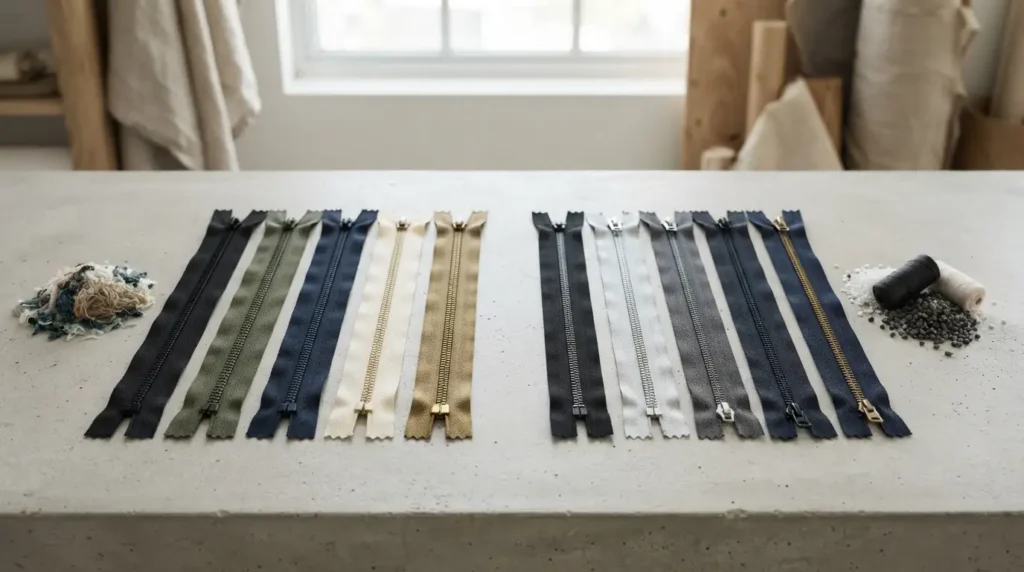
What Is a Sustainable Zipper?
Traditional zippers are commonly made with virgin polyester, nylon, or metal. These materials are functional and widely available, but virgin synthetic materials are generally produced from newly extracted resources.
Sustainable zippers can use a different approach. Common options include:
- Recycled polyester, including polyester made from recycled PET bottles
- Recycled nylon, including material recovered from industrial waste or discarded fishing nets
- Recycled metal for certain zipper components
- Bio-based materials in selected applications
- Manufacturing processes designed to reduce waste or the use of certain chemicals
Certification can provide another layer of verification. The Global Recycled Standard (GRS), for example, covers recycled content as well as social, environmental, and chemical requirements for certified processing. The Recycled Claim Standard (RCS) focuses primarily on verifying and tracing recycled material through the supply chain.
This distinction matters. A zipper described as “eco-friendly” does not necessarily tell a buyer how much recycled material it contains or whether the material can be traced back through the supply chain.
Sustainable Zippers vs Traditional Zippers: What’s the Difference?
| Factor | Traditional Zippers | Sustainable Zippers |
| Raw materials | Mainly virgin materials | Recycled or alternative materials |
| Virgin resource demand | Generally higher | Can be reduced through recycled content |
| Carbon footprint | Depends on material and production | Can be lower when recycled feedstock replaces virgin material |
| Recycled content | Usually none | Can vary by product |
| Traceability | Depends on supplier | Often supported by certification |
| Manufacturing impact | Depends on process | Depends on material and production controls |
| End-of-life | Depends on the finished product | Still depends on product design and material separation |
The key point is that “sustainable” describes an approach, not a single material. A recycled nylon zipper and a recycled metal zipper may have very different production processes and environmental impacts.
Environmental Impact Across the Zipper Life Cycle
1. Raw Material and Resource Consumption
The first difference appears before a zipper is manufactured.
Virgin polyester and nylon require new raw materials. Recycled polyester, on the other hand, can be produced from existing polyester waste rather than relying entirely on new feedstock. Recycled nylon follows a similar principle.
For brands, this is one of the clearest reasons to consider recycled zippers. Using recycled material can reduce dependence on virgin resources and give existing waste a second use.
However, recycled content should always be checked rather than assumed. A product containing a small percentage of recycled material should not be presented as equivalent to a zipper made with a high percentage of certified recycled content.
2. Carbon Footprint
Carbon emissions are often the most discussed environmental benefit of recycled materials, but there is no single reduction figure that applies to every sustainable zipper.
The actual result depends on the material, recycled content, energy used during production, transportation, and finishing processes.
There are, however, real examples showing that the difference can be measurable. YKK reports that its NATULON® #3 20 cm closed-end coil zipper produces approximately 19.6% lower greenhouse gas emissions during production than a standard YKK coil zipper, based on its life-cycle assessment.
This is a useful example, but it should not be treated as an industry-wide figure. Different zipper constructions and manufacturing systems will produce different results.
For a brand making environmental claims, product-specific data is therefore more useful than a general statement such as “recycled zippers reduce carbon emissions by 50%.”
3. Water and Energy Use
Water and energy consumption are more difficult to compare because zipper production involves several processes.
For textile zippers, these may include:
- Yarn or filament production
- Weaving or knitting
- Dyeing
- Forming the zipper elements
- Slider production
- Washing and finishing
Metal zippers may also involve melting, casting, polishing, plating, and other surface treatments.
Using recycled material can reduce the environmental burden associated with producing virgin feedstock, but it does not automatically make every stage of manufacturing low-impact.
This is why brands should look beyond the raw material and ask suppliers about the complete manufacturing process when environmental performance is an important purchasing requirement.
4. Manufacturing and Surface Treatment
The zipper tape is only one part of the product.
For metal zippers, plating and finishing can have a significant effect on the overall environmental profile. For plastic and coil zippers, dyes, coatings, and other treatments also need to be considered.
A zipper made with recycled material can still involve relatively intensive finishing processes. Conversely, improvements in manufacturing can reduce environmental impact even when the zipper itself is not made entirely from recycled material.
For this reason, sustainable sourcing is better viewed as a combination of material selection and manufacturing practices, rather than simply changing one raw material.
5. Waste and Plastic Pollution
Recycled zippers can also play a role in waste reduction.
Using recycled polyester, for example, creates a market for material that has already entered a waste stream. Instead of producing new polyester from virgin feedstock, manufacturers can use recovered material as an input.
This does not mean that using recycled polyester solves plastic pollution. It simply means that existing material can be kept in productive use for longer.
The same principle applies to recycled nylon and certain recycled metal components.
6. End-of-Life and Recyclability
This is where the comparison becomes less straightforward.
A recycled zipper is not necessarily easier to recycle after a garment or bag reaches the end of its life.
The zipper may be attached to several other materials, including fabric, thread, coatings, labels, and adhesives. Whether the final product can be efficiently recycled depends on the overall product design and available recycling infrastructure.
For brands working toward circular product design, it is therefore worth considering:
- Whether the zipper can be separated easily
- Whether its material composition is clearly documented
- Whether different materials are unnecessarily combined
- Whether the finished product has a realistic recycling route
The goal should not simply be to make one component recycled. The wider product should also be considered.
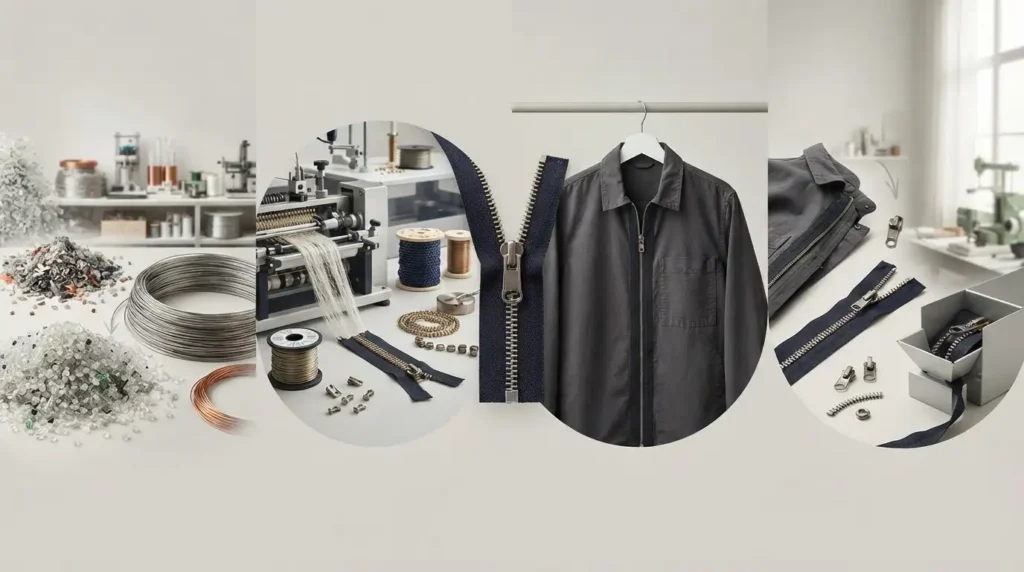
Recycled Nylon vs Recycled Polyester vs Recycled Metal Zippers
Different applications may call for different sustainable zipper materials.
Recycled polyester zippers are commonly suitable for apparel, bags, accessories, and other textile products where polyester tape or coil construction is appropriate.
Recycled nylon zippers can be considered when durability, abrasion resistance, and performance are important. They are particularly relevant to outdoor clothing, technical garments, and bags.
Recycled metal zippers offer another option for products that require the appearance, weight, or durability associated with metal hardware. However, the environmental impact needs to account for metal processing and surface treatments rather than recycled content alone.
There is no universal “best” sustainable zipper. The right choice depends on the product, performance requirements, design, and environmental goals.
Do Sustainable Zippers Perform as Well as Traditional Zippers?
This is one of the most common concerns when brands consider recycled materials.
Recycled content does not automatically mean lower performance. A zipper should still be evaluated according to its intended application and tested against the relevant requirements.
Depending on the product, buyers may need to consider:
- Tensile strength
- Abrasion resistance
- Slider performance
- Colorfastness
- Wash resistance
- Corrosion resistance
- Water resistance for waterproof applications
The quality of the raw material, manufacturing process, zipper construction, and testing standards all matter.
For this reason, brands should request product specifications and test reports rather than assuming that a sustainable zipper will perform either better or worse than a conventional one.
Are Sustainable Zippers More Expensive?
The answer varies.
Pricing can be affected by the type of recycled material, recycled content percentage, certification requirements, order quantity, customization, and production volume.
A certified recycled zipper may cost more than a comparable standard zipper, but price should not be considered in isolation. For brands selling into markets where sustainability documentation is increasingly important, verified recycled content and supply-chain traceability may also provide commercial and compliance value.
The best approach is to compare products based on material, certification, performance, MOQ, and total purchasing requirements, rather than looking only at the unit price.
Certifications to Look for in Sustainable Zippers
Certification is particularly useful when a brand needs evidence to support a recycled-material claim.
The GRS is widely used for products containing recycled materials. Textile Exchange states that GRS has a minimum recycled content requirement of 50% and includes additional social, environmental, and chemical requirements.
The RCS focuses on verifying and tracing recycled material through the supply chain.
OEKO-TEX® STANDARD 100 addresses a different issue. It tests textile products and components for harmful substances and is therefore useful when product safety is part of the sourcing requirement. It should not be treated as a recycled-content certification.
When sourcing sustainable zippers, brands should check the actual certificate, scope, material composition, and certified percentage rather than relying only on a sustainability label.
Are Sustainable Zippers Actually Better for the Environment?
In many cases, they can be.
Replacing virgin material with verified recycled material can reduce reliance on new resources and, depending on the material and manufacturing process, lower the environmental impact associated with production. Industry examples such as YKK’s NATULON® LCA demonstrate that measurable reductions are possible.
But the most responsible comparison looks beyond the zipper label. Material sourcing, manufacturing, finishing, durability, transportation, and end-of-life treatment all contribute to the final environmental footprint.
For apparel, bag, outdoor, and accessory brands looking to improve their material choices, sustainable zippers are one practical part of a broader environmental strategy. Choosing recycled materials with reliable certification and traceability can make the sustainability claim easier to verify—and easier to communicate with confidence.

Looking for the Right Zipper for Your Product?
Sustainability is an important consideration, but it is not the only one. Depending on your product, target market, performance requirements, and budget, a traditional zipper may still be the right choice, while recycled or other sustainable options can provide a better fit for brands with specific environmental goals.
Luxzipper offers both conventional and sustainable zipper solutions for apparel, bags, outdoor products, and other textile applications. Our range includes standard zippers as well as recycled options with certifications such as GRS, allowing brands to choose the material and specifications that best match their products.
Whether you need a reliable traditional zipper or want to explore a more sustainable alternative, contact Luxzipper to discuss your requirements, request product specifications, or get samples for evaluation.